

Business analysis is not only about writing requirements or managing a backlog. It is about creating clarity, asking the right questions, validating what you have understood, and helping business and technical teams move in the same direction.
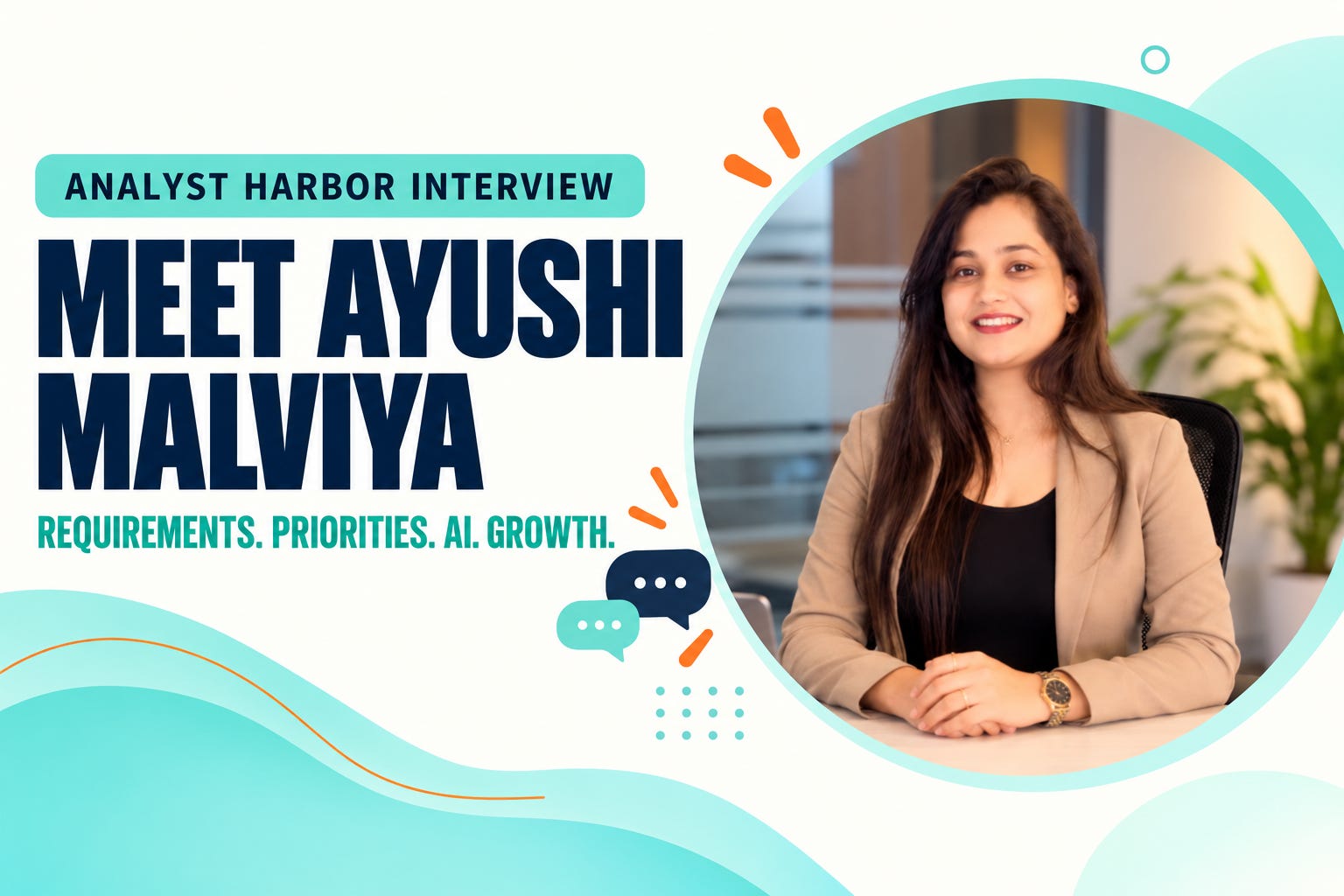
For Ayushi Malviya, that journey began in credit risk and quality assurance. Working with data, validation, requirements, and automation gradually brought her closer to the business analyst role.
In this interview, Ayushi shares how she organises her day, protects important decisions from being lost, validates requirements, and uses AI without allowing it to replace professional judgement.
This conversation is part of the Analyst Harbor interview series, where we speak with practising business analysts about their careers, working methods, tools, and lessons learned. Our goal is to give junior analysts an honest and practical view of how business analysis works in real projects.
From Credit Risk and QA to Business Analysis
1. How did you become a business analyst, and what attracted you to this profession?
I started my career in credit risk and quality assurance, where I worked closely with requirements, data validation, and automation.
Over time, I realised that I enjoyed bridging the gap between business needs and technical solutions. The business analyst role attracted me because it combines problem-solving, communication, and analytical thinking. It allows me to help organisations deliver value while reducing risk.
Organising the Work
2. How do you organise your working day and set priorities when you have meetings, analysis work, and several different tasks to manage?
I begin by reviewing my calendar and task list. I then prioritise my work based on urgency, dependencies, and stakeholder impact.
Critical meetings and deliverables come first, followed by analysis work that requires concentration. I also block out time for focused work to avoid constant context switching.
3. Which tools do you use most frequently, and how does each of them support your work?
Jira and Confluence for backlog management, user stories, and documentation.
SQL and Excel for data validation and analysis.
Visio and Figma for process flows and wireframes.
Power BI for dashboards and reporting.
Together, these tools help me capture requirements, analyse data, visualise processes, and communicate clearly with stakeholders.
4. How do you take notes during meetings and ensure that important requirements, decisions, and action items are not lost?
I use structured templates in OneNote or Confluence to capture decisions, action items, and their owners.
Immediately after the meeting, I summarise the key points and share them with stakeholders to confirm that my understanding is accurate. This also gives everyone an opportunity to correct or clarify anything that may have been misunderstood.
5. How do you make sure that you have correctly understood the business requirements before you document them or propose a solution?
I validate my understanding through stakeholder workshops, playback sessions, and clarifying questions.
I restate the requirements in simple terms and confirm them with business users. This helps ensure that everyone is aligned before I begin documenting the requirements or proposing a solution.
Using AI Without Losing Professional Judgement
6. How do you currently use AI in your work? Which activities does it help you with the most?
AI helps me summarise meeting notes, prepare initial drafts of user stories, create process flows, and analyse large datasets more quickly.
It reduces manual effort and speeds up documentation, giving me more time to focus on analysis and communication.
7. Can you share a specific example of a task that AI helped you complete faster or to a higher standard?
During a mobile application project for gold loans, I used AI to create structured user stories from stakeholder discussions.
This saved several hours of manual writing and helped maintain consistency across the backlog items.
8. How do you verify the accuracy of AI-generated outputs?
I cross-check AI-generated outputs against source data, business rules, and stakeholder feedback.
I treat AI as a tool for creating an initial draft, not as a final authority. Everything must be reviewed and validated before it is used.
9. Are there situations in which you prefer not to rely on AI?
Yes, particularly when I am working with sensitive data, regulatory requirements, or complex stakeholder negotiations.
In these situations, human judgement, professional experience, and domain expertise are essential.
10. Does your organisation have rules for using AI and handling confidential or internal information? How do these rules affect your work?
Yes, we have clear guidelines. AI tools cannot be used with confidential client data or proprietary information.
These rules help protect data and ensure compliance. I therefore use AI mainly for generic activities, such as preparing documentation drafts, creating analysis templates, and supporting knowledge sharing.
What Comes Next?
11. Which tool, organisational method, or AI-related skill would you like to improve next, and what would you recommend to other junior business analysts?
I would like to deepen my expertise in process automation and AI-driven analytics.
For junior business analysts, I recommend mastering the fundamentals first: clear documentation, effective stakeholder communication, and structured analysis.
Once these foundations are in place, AI tools can gradually be introduced to improve efficiency. AI can make the work faster, but it cannot replace a solid understanding of business analysis.
What We Can Learn from Ayushi
Ayushi’s answers show that effective business analysis is not defined by one tool, template, or methodology. It comes from a disciplined way of working: prioritising carefully, confirming what you have understood, documenting decisions, protecting sensitive information, and continuing to learn.
AI may change how some tasks are completed, but the foundations remain the same. Business analysts still need to create clarity, connect people, challenge assumptions, and ensure that the proposed solution addresses the real business need.
Who Should We Interview Next?
Do you know an interesting business analyst whose work deserves more attention?
Perhaps they have an unusual career journey, a practical way of solving problems, or valuable lessons that could help other analysts grow.
Let us know! :)
Leave their name in the comments or send us a message with a link to their profile. We are always looking for analysts who deserve the chance to share their experience with the Analyst Harbor community.