

Business analysis certifications can be valuable, but only when they are tied to the role you want next.
A certification can strengthen credibility, improve job prospects, build confidence, and support stronger earning potential. For experienced analysts, credentials such as CBAP can be especially useful because they help signal senior-level capability.
But the real value does not come from passing an exam. It comes from choosing the right certification for your level, using the preparation process to improve how you work, and continuing to build on it after the exam.
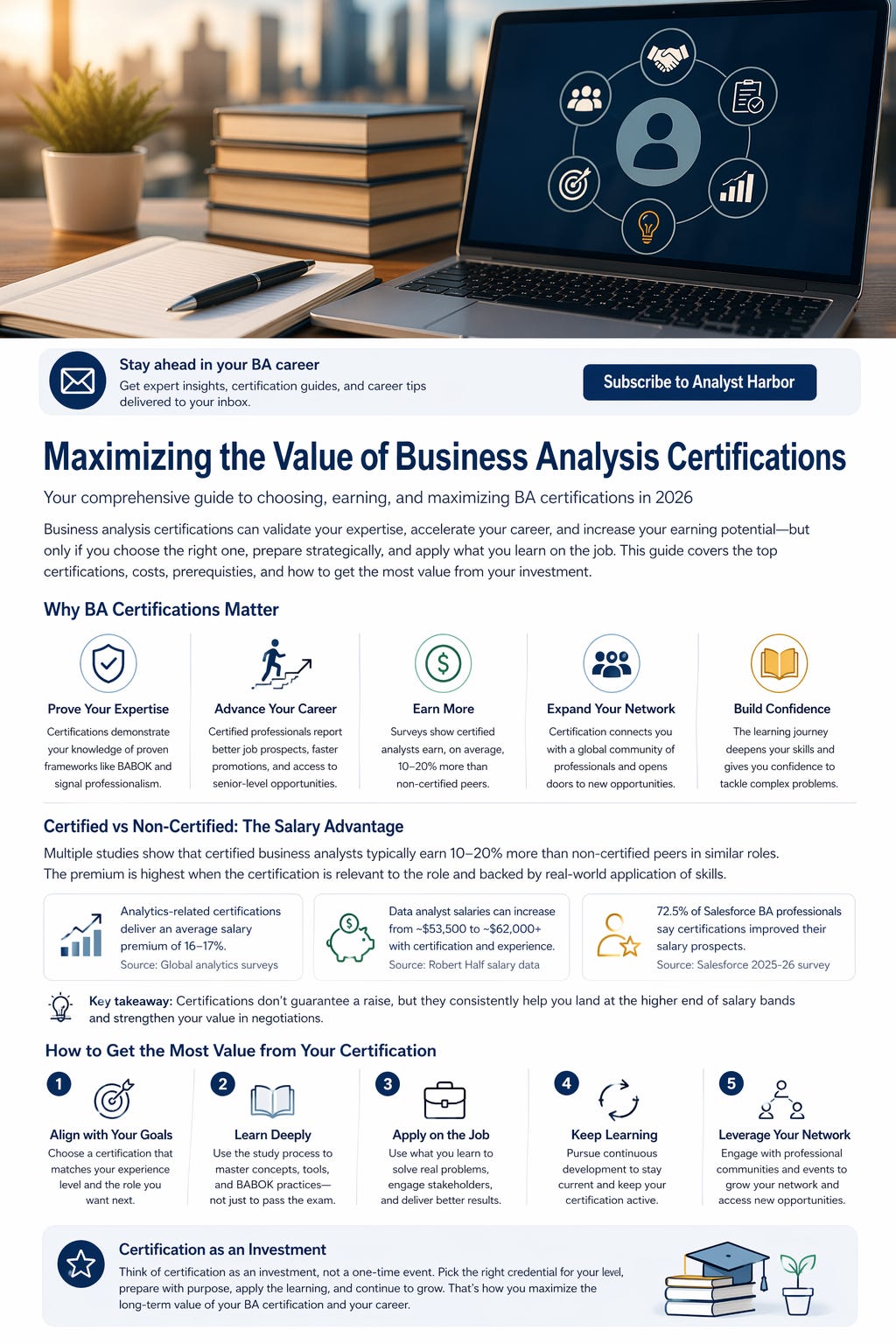
Why certifications matter
A good BA certification can help in three ways.
First, it gives employers and stakeholders a clearer signal of your capability.
Second, it helps you speak about your work more confidently and more professionally.
Third, it can improve your market position. Certified professionals often report better career satisfaction, stronger visibility in hiring, and better compensation than non-certified peers in similar roles.
The biggest mistake people make
The most common mistake is treating certification as the finish line.
Passing the exam is useful, but the badge alone will not transform your career. The value becomes much higher when certification helps you do better stakeholder work, define requirements more clearly, support decisions better, and position yourself for the next role.
A better mindset is this: certification is not decoration. It is leverage.Start with the role you want next
Before choosing any certification, ask yourself one practical question.
What role am I trying to move into next?
That matters more than choosing the most impressive-sounding credential.
If you are early in your career, an entry-level certification may give you better return than jumping straight to a senior-level option.
If you already have substantial BA experience, a senior certification such as CBAP may be the better choice because it helps prove maturity, depth, and readiness for advancement.
Common business analysis certifications
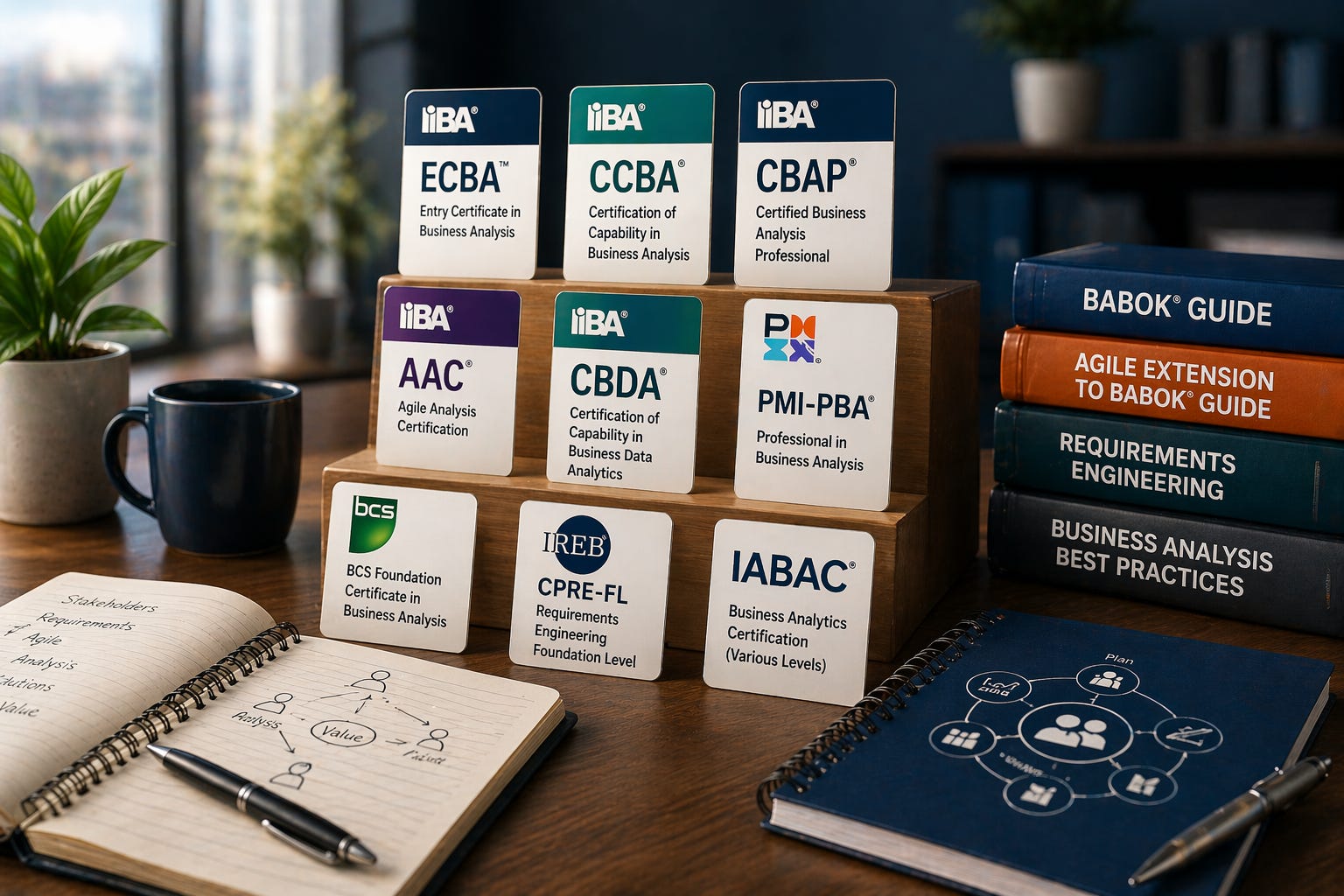
Here are the certifications most people come across when planning a BA career.
ECBA
A strong entry-level certification for beginners, junior analysts, and career changers. It is best when you want structure, foundational knowledge, and a first recognized credential.
CCBA
A good mid-level option for analysts who already have hands-on experience and want to show they can apply BA practices consistently.
CBAP
The best-known senior-level BA certification. It is designed for experienced professionals and is often the strongest option when you want to signal senior capability, improve credibility, and support career progression.
PMI-PBA
A useful option if your work sits close to project management, delivery governance, or PMO-style environments. It can be a good fit for analysts working in project-heavy organizations.
AAC
A certification for analysts working in agile environments. It is useful if your work is strongly connected to agile delivery, product collaboration, and iterative requirement work.
CBDA
A good choice if your BA role is becoming more data-driven. It suits analysts who work with analytics, decision support, and business data interpretation.
BCS Foundation in Business Analysis
A well-known option in the UK and Europe, especially for people who want a structured introduction to business analysis.
CPRE
A strong certification path for people whose work is heavily focused on requirements engineering rather than broader business analysis.
Which certification should you pick
A simple rule helps here.
Choose the certification that matches both your current level and your next realistic move.
Pick ECBA or a similar foundation-level certification if:
You are new to business analysis.
You are moving into BA from another role.
You want a recognized credential that helps you learn the basics and talk about your work with more confidence.
Pick CCBA or a similar mid-level certification if:
You already have real BA experience.
You want to prove consistency and strengthen your profile for broader responsibility.
You are aiming for stronger BA roles but are not yet at the senior-most level.
Pick CBAP if:
You already have substantial business analysis experience.
You want to demonstrate senior-level capability.
You are aiming for lead BA, principal BA, consulting, or more strategic roles.
You want a credential that improves credibility in promotion or hiring conversations.
When CBAP makes the most sense
CBAP is most valuable when you already have enough experience to make the certification believable and useful.
At that stage, it can help validate your track record, strengthen your professional reputation, and position you for more senior opportunities. It is especially useful when you want your experience to be understood in a clear, market-recognized way.
For experienced analysts, that is where CBAP often delivers the strongest return.
How to get the most value from certification
The best return comes from doing three things well.
1. Study to improve your real work
Do not prepare only to pass the exam. Use the learning to sharpen stakeholder analysis, requirement quality, facilitation, and decision support.
2. Apply the ideas on the job
This is where certification becomes real.
For example, if you are studying BABOK-aligned practices, use them in real stakeholder work. Build a better stakeholder map. Improve your workshop structure. Write clearer scenarios and acceptance criteria. Support business cases more clearly.
3. Keep building after the exam
A certification is more valuable when it stays active and becomes part of your long-term professional development.
That might mean continuing your learning, mentoring others, improving your BA toolkit, or using the credential to reposition yourself for the next role.
A practical decision guide
Use this quick filter.
Choose certification if it matches your experience, supports your next step, and helps you improve real work.
Delay it if you are picking it only because it sounds impressive or because you expect the badge alone to change your career.
Final thought
Business analysis certifications are worth most when they are treated as an investment, not a trophy.
If you are early in your career, choose a certification that helps you build foundations.
If you already have substantial experience, CBAP can be a strong option for proving senior capability and supporting advancement.
In both cases, the pattern is the same.
Pick the certification that fits your level.