


One Monday morning, a junior analyst walked into a meeting feeling very proud. He had updated one tiny number in a rule. Just one. A harmless little threshold change.
By Tuesday, Compliance was asking questions, Operations had found three broken cases, QA looked like they had aged five years overnight, and someone from Risk said, “This is why I do not sleep well.”
The analyst stared at the screen and said, “But it was only one number.”
That is the funny thing about regulatory change. It never arrives alone. It comes with cousins, neighbours, and a suitcase full of consequences.
If you work as a business analyst in banking or insurance, this will feel familiar. Regulatory changes often look small at first. But if you handle them loosely, they become slow, messy, and expensive very quickly.
The good news is this: you do not need a mountain of documents to manage them well. You need a simple way to think, ask the right questions, and keep the team aligned.
Today, I want to share a practical six step framework to help you handle regulatory requirements with more confidence and a lot less bureaucracy.
What business analyst should do in regulatory change
When a regulatory change lands on your desk, your job is not just to write requirements. Your job is to make the change clear enough that nobody has to guess what it means.
In regulated industries, guessing is dangerous. A missing detail is not just a bug waiting to happen. It can become a customer issue, an audit problem, a release delay, or a costly fix after go live.
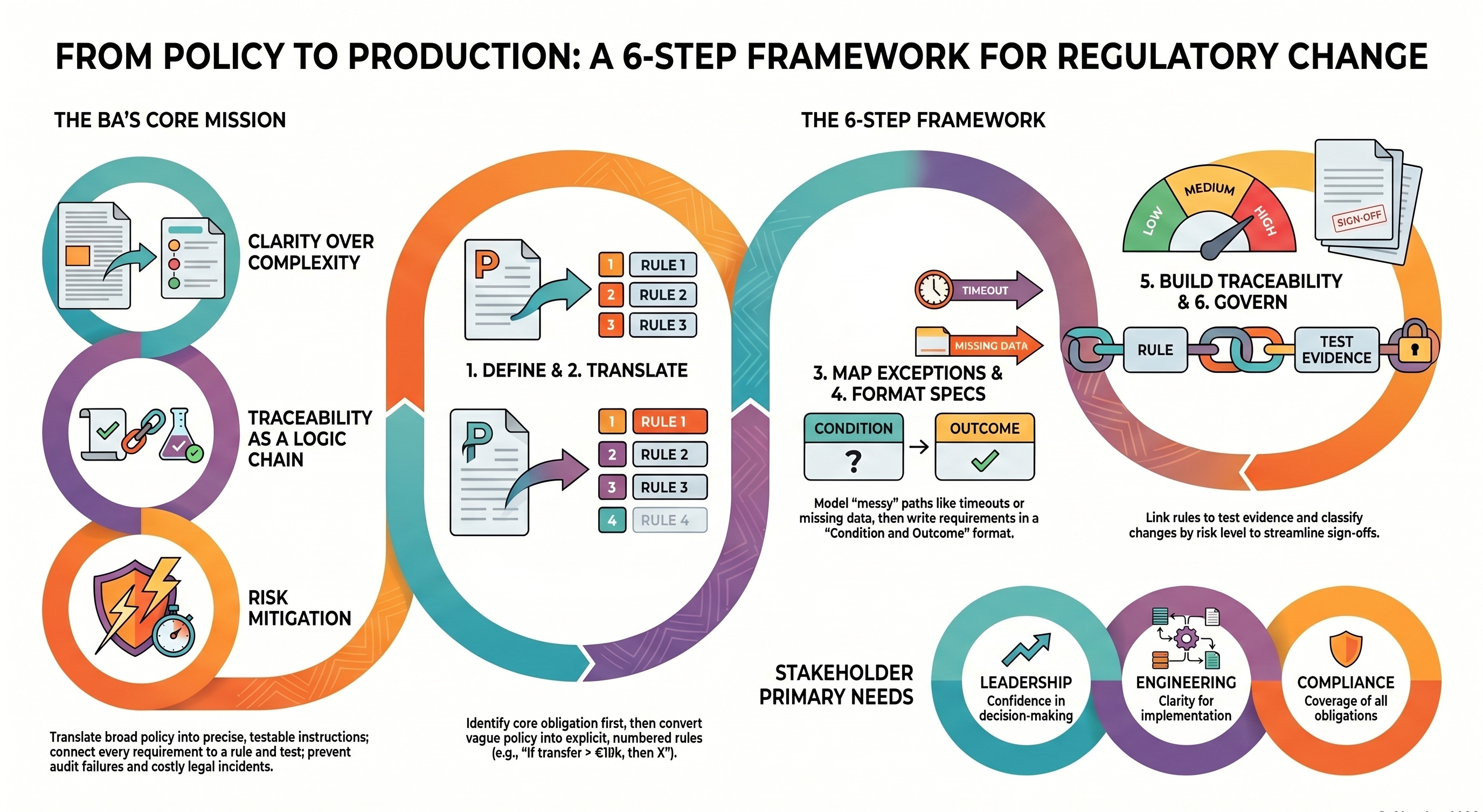
That is why the business analyst plays such an important role here. You should focus on three things.
Clarity
Take unclear policy language and turn it into something the team can actually use. Legal or compliance text is often broad and formal. Engineers, testers, and operations teams need something precise.
Traceability
You should be able to show how one thing connects to another. Why does this rule exist? Which requirement supports it? Which test proves it works? This matters a lot when questions come later.
Controlled change
A regulatory update can affect several teams at once. Product, Compliance, Risk, Engineering, QA, and Operations all need to see the same picture early.
In many product teams, unclear requirements create extra work. In regulated teams, unclear requirements create risk.
That is the big difference.
In a less regulated setting, the team may say, “We will fix it next sprint.” In banking or insurance, the same problem can trigger an incident, an audit finding trust me, you really do not want to do that).
So what should a junior BA remember?
What is changing
Why it is changing
What rule or obligation sits behind it
What could go wrong if it is misunderstood
How the team will prove the change works
That is where good BA work becomes visible. Not in the number of pages written, but in the number of surprises avoided.
What stakeholder expect in regulators changes
Stakeholders usually do not ask for “better requirements.” They ask for outcomes and usually want to know this:
Are we reducing risk or just moving it somewhere else
Can we deliver this change without chaos before release
Can we explain our decisions if an audit happens
Do people understand the trade offs before they become problems
That means your work as a BA should help answer those questions.
A stakeholder does not care that your document is beautifully formatted if the team still does not know what to build.
What they do care about is whether the change is clear, testable, and connected to the real obligation behind it.
Even simple tracking can make BA quality more visible. For example, a team can look at:
How many incidents came from unclear requirements
How many important changes went ahead without full traceability
How many audit issues were linked to missing controls or vague requirements
How long it took to move a change from request to release readiness
These are much more useful than counting pages, meetings, or templates.
6 steps framework
The six steps below are designed to keep things lean. They give you structure, but they do not bury the team in paperwork.
Step 1: Define the objective and the obligations
Start with one clear objective.
What exactly is the change trying to achieve?
Then identify the obligations connected to it. These might come from regulation, internal policy, compliance guidance, or risk controls.
Do this before people jump into solution mode. If the team starts designing too early, they may build something clever that solves the wrong problem.
Output: a short BRD style note with scope, constraints, assumptions, and owners.
Step 2: Convert policy into explicit, testable rules
Policy language is rarely written in a way that delivery teams can use directly.
Your job is to translate it into plain, testable rules.
For example:
If a transfer is above 10,000 EUR, enhanced due diligence must be completed before processing.
That is much easier for a team to work with than a paragraph full of policy wording.
When you write rules, keep them specific. One rule should describe one clear expectation.
Output: a numbered rule list that can be reviewed and tested.
Step 3: Model controls and exception paths before build begins
Teams naturally focus on the main path. But regulated processes often fail in the messy parts.
Think about cases like:
Invalid input
Missing data
Duplicate requests
Sanctions match
Timeout from an external service
Manual review needed
These are the moments where control gaps appear.
A junior BA can add huge value by asking, “What happens if this goes wrong?” before development starts.
Output: a process map that shows the main flow and the exception paths.
Step 4: Write functional requirements in condition and outcome format
A requirement should help the team understand when something happens and what the system must do.
That makes it easier for engineers to implement and easier for QA to test.
For example:
If screening stays pending for more than 30 seconds, the system returns REVIEW PENDING and creates an audit event.
This style removes guesswork. It gives the team a condition and an expected result.
When writing requirements, ask yourself:
Is this specific enough to build
Is this specific enough to test
Would two different people read it and understand the same thing
If the answer is no, rewrite it.
Output: a requirement set with clear pass or fail logic.
Step 5: Build traceability before coding starts
Traceability sounds scary at first, but it is really just a chain of logic.
You want to connect:
Objective
Rule
Requirement
Test
Evidence
This makes life easier later. If someone asks why a requirement exists, you can show it. If an auditor asks how the rule was tested, you can show that too.
Traceability also helps with impact analysis. If one rule changes, you can quickly see which requirements and tests are affected.
Output: a simple traceability matrix.
Step 6: Govern change continuously
Not every change needs the same level of control.
Some changes are low impact. Some are high risk and need closer review.
That is why it helps to classify change requests. A simple low, medium, high approach is often enough.
For higher impact changes, make sure the team agrees on:
Who must review and sign off
What evidence is needed before release
What rollback condition exists if something goes wrong
This keeps governance practical. It is not about slowing people down. It is about making sure the right eyes are on the right changes.
Output: a change log that stays with the release and records decisions clearly.
Final thoughts
In banking and insurance, requirement work is not about producing paperwork for its own sake. It is about helping teams deliver safely, clearly, and with fewer nasty surprises.
In the next article, we will go deeper into the mistakes that often make regulatory change harder than it needs to be. We will also share a compact template created especially for legal and regulatory requirements, to help you stay clear, structured, and practical. Stay tuned!