

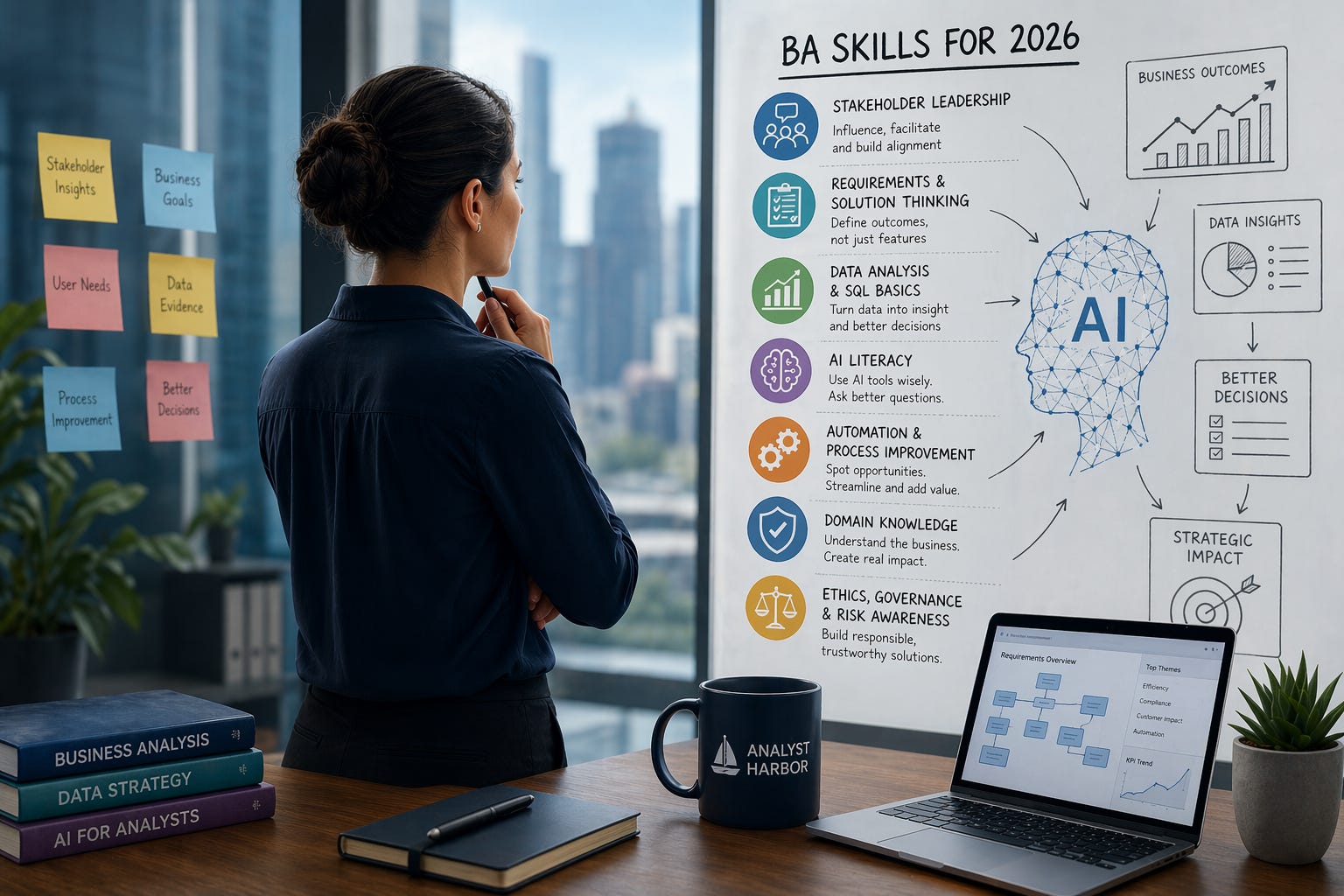
Open any business analyst job posting today and you will find the same list.
Requirements gathering. Stakeholder management. Agile. SQL. Power BI. Communication skills. Ability to work in a fast-paced environment.
In 2026, business analysis is moving beyond documentation and requirement capture. The role is becoming more strategic, more judgment-based, and more closely tied to decision quality.
AI is changing how work gets done. Data is no longer optional. And the analysts who stand out are the ones who can connect business goals, stakeholder needs, and operational reality with far more precision than before.
The gap between what job descriptions say and what strong BA work actually requires is now too large to ignore.
Why the role is changing
The biggest shift is simple: analysts are spending less time producing raw material and more time interpreting it.
AI tools can already support note-taking, summarisation, draft requirements, and first-pass analysis. That does not make the BA obsolete. It makes weak analysis easier to automate and strong analysis more valuable.
As repetitive tasks become easier to delegate, the analyst’s value moves upward. The real work becomes deciding what matters, identifying what is missing, spotting risk early, and helping teams make better decisions with incomplete information.
That changes the profile of a strong BA.
It is no longer enough to collect requirements and document them neatly. Analysts are increasingly expected to facilitate decisions, translate data into business meaning, and challenge unclear thinking before it becomes expensive.
Lucia’s view: the most important shift is not technical. It is the rising value of judgment. Good analysts do not just record what stakeholders say. They test it, clarify it, and identify what is still unresolved. In practice, that means knowing when a requirement is incomplete, when a risk is being ignored, and when a team is moving forward on assumptions instead of evidence.
Milos’s view: the role is also becoming more structurally demanding. In technical and regulated environments, the BA now operates closer to contracts, rules, data structures, and control logic than many organisations realise. The analyst who is only comfortable with workshops and user stories will increasingly struggle if they cannot also read specifications, understand system impacts, and ask sharper questions about how a decision is actually made.
3 forces driving the change
AI is entering the requirement space. Systems that make decisions algorithmically — credit scoring models, fraud detection engines, clinical decision support tools — now need requirements just like any other system. But writing requirements for a model is not the same as writing requirements for a rule. The inputs, the failure modes, and the audit obligations are different. Most BA methodologies have not caught up.
Regulation is becoming a technical discipline. DORA, NIS2, PSD3, AI Act, GDPR enforcement. Regulatory change used to mean updating a policy document. Now it means tracing the impact across APIs, data models, audit logs, and operational processes — and documenting that trace in a way that satisfies both a project manager and a regulator. This is BA work, and it requires a different kind of fluency than it did five years ago.
The line between BA and data is dissolving. Not because BAs are becoming data scientists, but because the questions stakeholders are asking now — “why did this model decline that customer?”, “what does our data actually say about this process?” — cannot be answered without someone who can move between business language and data structure. That person is increasingly the BA.
The Skills That Actually Matter in 2026
The strongest BA skill set in 2026 is not a random collection of tools. It is a layered capability.
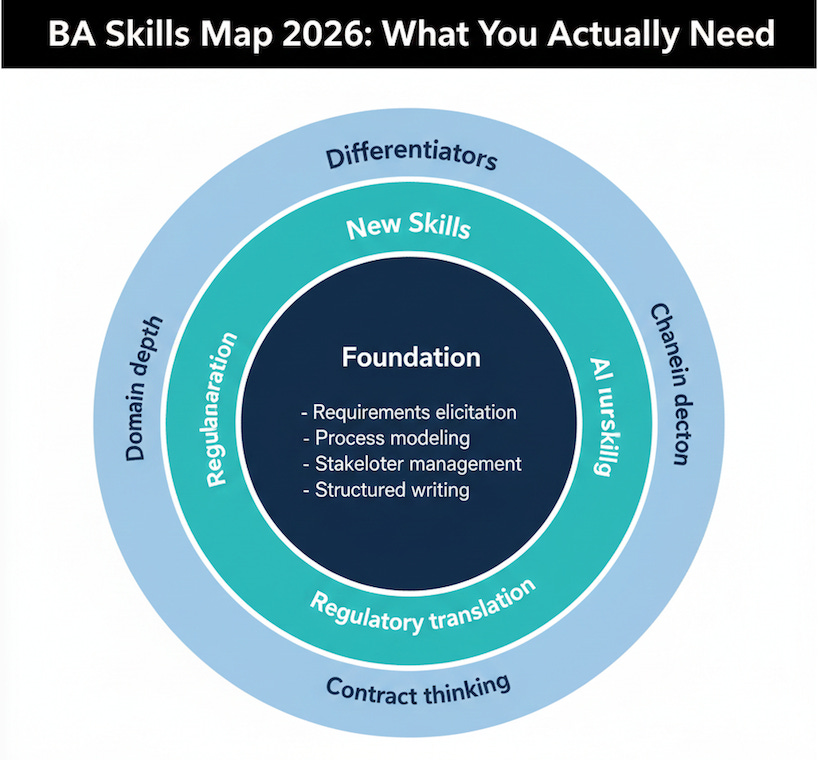
Some skills remain foundational. Some are rising fast. And some have become key differentiators precisely because most people still underestimate them.
The Foundation: Still Non-Negotiable
Requirements elicitation, process modeling, stakeholder facilitation, and written communication remain the core of the role. These are not going away. If anything, they matter more — because the environments in which BAs operate have become more complex, and the cost of ambiguity has risen.
What has changed is the bar. “Can write a user story” is no longer sufficient. The expectation is that a BA can write requirements that are precise enough to be tested, traceable to a business rule, and resilient to a change request three sprints later. That is a higher standard than most job descriptions capture.
The Genuinely New Skills
AI requirements literacy. This is the most underspecified skill in the market right now. Writing requirements for systems where an algorithm makes the decision requires understanding what the model needs as input, what it cannot be asked to guarantee, how failure should be defined and detected, and what the audit trail must capture. In regulated industries, this is not optional — it is the difference between a compliant system and a finding.
This does not mean BAs need to understand model architecture. It means they need to understand enough about how models behave to ask the right questions, define the right acceptance criteria, and push back when “the model decides” is offered as a substitute for a requirement.
Regulatory translation. The ability to read a regulatory text — a directive, a technical standard, an EBA guideline — and identify its operational implications for a specific system or process. Not as a compliance officer would, but as an analyst would: which business rules change, which data fields are affected, which API behaviors need to be documented or modified, which tests need to be added.
This skill is rare. Most BAs either defer entirely to legal and compliance teams, or try to interpret regulation without sufficient context. The analysts who can sit in the middle — who can have a productive conversation with both the compliance officer and the developer — are consistently the ones who move projects forward when regulatory requirements land.
A honest note on scope: regulatory translation is a critical skill in banking, financial services, healthcare, energy, and any environment where external regulation directly shapes system behavior. If you work in e-commerce, SaaS, or internal IT projects without significant compliance exposure, this is useful context but not a daily priority. The distinction matters — a skills map that tells everyone they need everything is not a skills map, it is a wish list.
Contract thinking. The ability to specify behavior — not just describe it. This applies to API contracts, data exchange agreements, and system integration points. A requirement that says “the system should return customer data” is not a contract. A requirement that defines the schema, the error codes, the latency expectations, the retry behavior, and the data sensitivity classification — that is a contract. The shift from description to specification is one of the most important transitions a BA can make.
The Underrated Differentiators
Domain depth. Generic BA skills travel. Domain knowledge is where leverage concentrates. A BA who understands how a payment settlement works, or how a clinical trial is structured, or how an energy trading desk operates — that person can ask better questions, spot missing requirements earlier, and challenge technical decisions that look correct on paper but are wrong in context.
Domain knowledge cannot be acquired from a course. It accumulates from time spent in an industry, asking questions, and building mental models of how things actually work. It is slow to develop and difficult to replicate. That makes it one of the most durable competitive advantages available to an analyst.
Structured writing. Not “good communication skills” in the generic sense — but the ability to write a requirement, a business rule, or a specification in language that is unambiguous, complete, and testable. This is a craft. It requires practice, feedback, and deliberate attention to precision. It is also, based on the quality of requirements that actually circulate in most organisations, genuinely rare.
Change detection. The ability to recognize when a scope change has occurred — even when no one has announced it — and surface it explicitly before it becomes a defect. This is partly analytical skill and partly organisational awareness. It is the difference between a BA who processes information and one who governs it.
What This Looks Like in Practice
Consider two business analysts working on the same type of project — implementing a new fraud detection system in a financial institution.
The first analyst gathers requirements from the fraud team, documents the happy path, writes user stories, and hands them to development. The system ships. Three months later, a compliance review identifies that the model’s decision logic cannot be reconstructed from the audit log. The fix requires a significant rework of the logging architecture.
The second analyst starts by asking a different set of questions. What does the regulator require in terms of explainability? What must the audit log capture for each decision? How should the model’s output be represented in requirements — as a rule, as a threshold, or as a probability band? What happens when the model is retrained — does the requirement change? The compliance review finds no gaps. The audit log was designed correctly from the start.
The difference is not technical skill. It is the frame through which requirements are approached.
What to Prioritize First When Choosing a New Business Analyst
For analysts building their 2026 skill stack, the smartest sequence is not to chase every trend at once.
A practical order looks like this:
First, strengthen stakeholder communication and facilitation.
Then improve requirements analysis and solution thinking.
After that, build basic data literacy and SQL confidence.
Next, develop AI and automation awareness.
Then deepen domain knowledge in your target industry.
Finally, improve storytelling and executive reporting.
That order matters because influence comes before tools.
Final thouths & the honest summary
Lucia’s closing view: the skills that will define the next generation of senior BAs are not technical — they are judgement-based. Knowing when a requirement is complete. Knowing when a stakeholder’s stated need differs from their actual need. Knowing when a project is heading toward rework and intervening early. These are not certifiable skills, but they are learnable — and they are what separates analysts who are managed from analysts who lead.
Milos’s closing view: in regulated and technical environments, the BA who cannot read a contract — whether that contract is an API specification, a regulatory text, or a data processing agreement — is operating with a significant blind spot. The work increasingly lives at the intersection of business intent and technical precision, and analysts who are comfortable only on one side of that line will find their scope narrowing as the role evolves.
The skills that make a BA genuinely effective in 2026 are not dramatically different from what they have always been — clarity of thought, precision of language, understanding of context. What has changed is the environment in which those skills are applied.
AI, regulation, and technical integration have raised the complexity of the problems BAs are asked to solve. The analysts who will thrive are the ones who extend their foundational skills into these new domains — not by becoming experts in everything, but by developing enough fluency to ask the right questions and recognise when they are getting incomplete answers.