

Recently, I had a profound conversation with a friend who, after five years, is considering leaving the company she’s been working for. This conversation struck a chord with me and inspired today’s article.
I want to explore why business analysts really leave—their projects, their bosses, their companies.
While my focus is on business analysts, these insights are relevant far beyond our profession and can be generalized to many other roles.
The depth of our discussion made me reflect on this question from multiple angles, and I realized that understanding why talented BAs walk away is crucial for organizations that want to retain their best people.
This led me to conduct research within our business analyst community to gather real experiences and perspectives.
Today, I’m sharing what I discovered.
Question 1: Why Do Business Analysts Leave?
The responses from our community revealed seven distinct patterns that drive business analysts to seek opportunities elsewhere.
Here’s what the data shows:
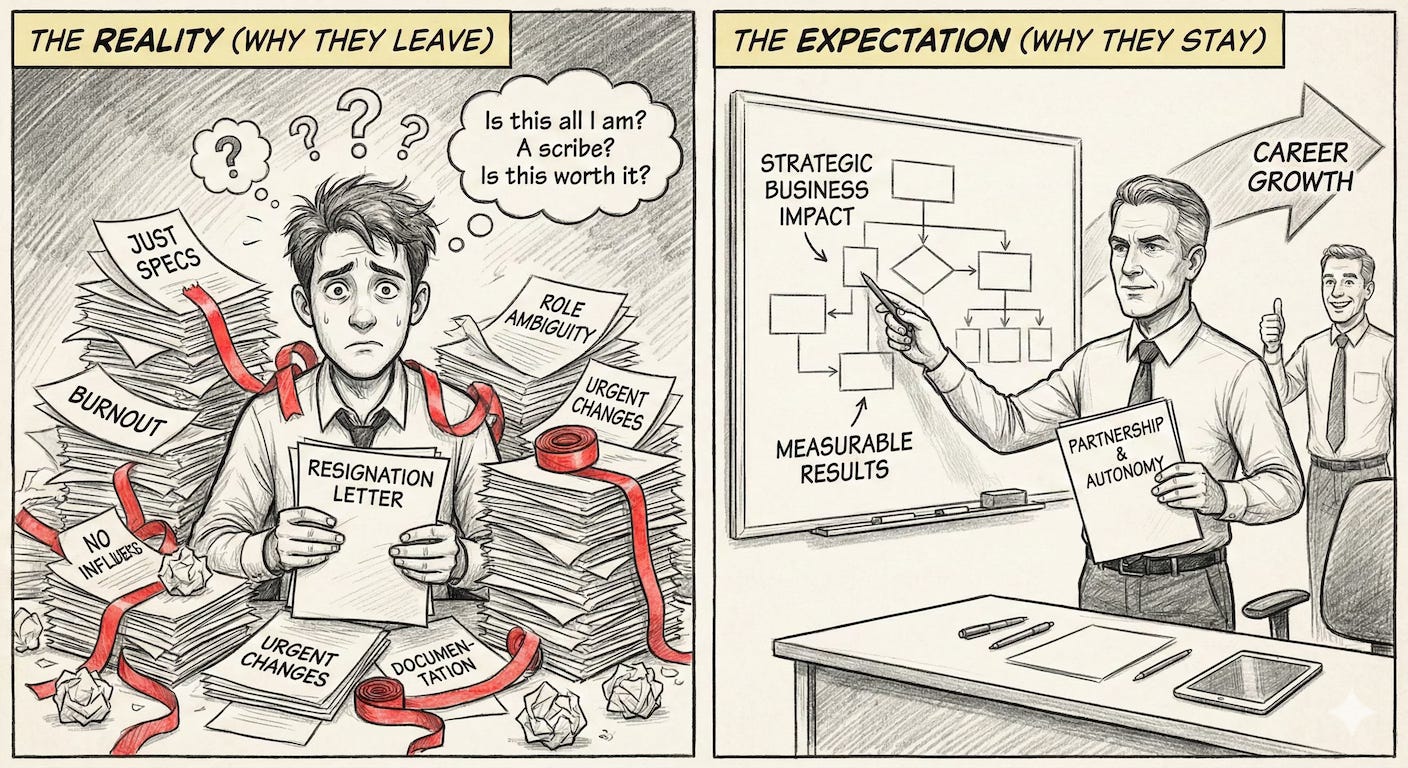
1. Role Ambiguity / Reduction to Documentation Provider (68%)
The most common complaint among departing BAs is being misunderstood. Many organizations view business analysts as “writers of specs” rather than active creators of business value.
The analyst becomes relegated to documentation duties, remaining outside critical decision-making processes even though their insights and deliverables are fundamental to project success.
When your role is reduced to “just document what we’ve already decided,” it’s no wonder talented analysts look elsewhere.
2. Limited Influence on Decisions (62%)
Even when analysts deliver well-researched recommendations backed by data and stakeholder insights, they often find themselves without the authority or platform to effectively influence what actually gets implemented.
They become executors rather than partners in the solution.
This disconnect between responsibility and influence creates frustration—you’re accountable for the analysis, but powerless to act on it.
3. Pressure on Speed and Compromises in Quality (57%)
Frequent requirement changes, unrealistic deadlines, and unclear expectations force analysts into an impossible position: sacrifice depth of analysis or cut corners on specification detail.
Neither option feels right.
This constant pressure to deliver “fast enough” rather than “good enough” erodes professional pride and creates a sense that quality simply doesn’t matter to the organization.
4. Overload and Risk of Burnout (54%)
Constant work under pressure.
Inability to disconnect and rest.
Taking on multiple roles simultaneously—analyst, project coordinator, tester, documentation specialist—all of this leads to exhaustion.
The result is inevitable.
Fatigue, loss of motivation, and ultimately, departure.
Burnout doesn’t happen overnight, but when it arrives, it’s often too late to recover the relationship with the employer.
5. Lack of Recognition and Visibility (48%)
When analysts don’t feel that leadership sees or values their work, they lose the sense that their effort matters.
Good analysis often prevents problems that never happen—which means the value is invisible.
Without visible feedback, appreciation, or acknowledgment, motivation gradually fades. People need to know their contributions make a difference.
6. Career Stagnation and Limited Growth Opportunities (45%)
They master their current role and then find themselves at a “dead end” with nowhere to grow.
When learning stops, engagement follows soon after.
7. Weak Managerial Support (41%)
A manager who doesn’t understand the BA domain, fails to negotiate removal of obstacles, or doesn’t provide meaningful feedback weakens both trust and psychological safety within the team.
When your manager can’t advocate for you, doesn’t protect your time, or can’t articulate the value you bring, you’re left to fight battles alone.
Eventually, that becomes exhausting.
Question 2: What Do Business Analysts Expect from Themselves?
Understanding why analysts leave is only half the story.
The other half lies in understanding what drives them.
When I asked our community about their personal expectations, a clear picture emerged of what motivates BAs to stay engaged and committed.
1. Growth and Development (76%)
Business analysts are lifelong learners by nature.
They expect continuous growth.
When they stop learning, they start looking for their next opportunity.
Growth isn’t a nice-to-have; it’s oxygen for a BA’s career.
2. Meaning and Impact (71%)
BAs don’t just want to produce deliverables.
They want those deliverables to matter.
Documents that sit unused on a shelf represent wasted potential.
Analysts want to see the thread from their work to tangible business results.
3. Professionalism and Quality (69%)
They expect to deliver work they can be proud of.
Being forced to cut corners or deliver “good enough for now” solutions due to external pressure conflicts with their internal sense of craftsmanship.
Quality matters.
4. Autonomy and Responsibility (64%)
They don’t want to be micromanaged.
Forced into rigid templates that don’t fit the situation.
With autonomy comes responsibility, and BAs are ready to own both.
5. Respect and Recognition (58%)
Analysts expect to be taken seriously as specialists with valuable expertise.
Respect isn’t about ego—it’s about being treated as a strategic partner rather than an administrative function.
6. Work-Life Balance (52%)
BAs expect reasonable boundaries that allow for regeneration and life outside work.
They’re willing to work hard and occasionally put in extra hours during critical periods.
Chronic overload isn’t sustainable.
Space to rest, reflect, and recharge isn’t a luxury—it’s necessary for sustained high performance.
7. A Clear Career Path (47%)
Analysts want to know where they can go next.
A visible path forward—even if it’s not perfectly linear—provides direction and motivation.
Question 3: What Do Business Analysts Expect from Their Managers and Leadership?
If self-expectations form the internal compass for BAs, then management expectations form the external environment that either enables or constrains their success.
When I asked what analysts need from their leaders, ten clear themes emerged—and together, they paint a picture of leadership that either retains talent or drives it away.
1. Clarity of Goals and Expectations (82%)
Analysts need to know the purpose of their tasks.
How success will be measured.
Vague directives like “just document the requirements” or “figure out what they need” without clear objectives create confusion and wasted effort.
Clear goals aren’t about control—they’re about alignment and focus.
2. Constructive and Regular Feedback (78%)
BAs want feedback that goes beyond pointing out mistakes.
They need direction for improvement.
Insight into blind spots.
Regular feedback—not just annual reviews—helps analysts course-correct quickly and grow continuously.
Silence is often interpreted as indifference.
3. Support for Growth and Mentoring (74%)
Strong managers delegating challenging assignments.
When managers actively cultivate their team’s capabilities, they signal that growth matters.
When they don’t, talented people find mentors elsewhere—often at a new company.
4. Trust and Freedom to Make Decisions (71%)
Micromanagement kills motivation.
Analysts expect their managers to give them responsibility and trust them to execute.
This doesn’t mean abdication—it means delegating authority alongside accountability.
When managers constantly second-guess or override professional judgment, they communicate that the analyst’s expertise doesn’t matter.
5. Removing Obstacles and Advocating for the Team (69%)
When the team hits limits the manager’s job is to intervene at higher levels.
BAs can’t fight every battle themselves.
They need leaders.
They need shield from unnecessary organizational friction.
6. Visibility for the Team with Stakeholders (66%)
Managers should ensure that BA work is heard by business decision-makers and that credit flows to the right people.
When leaders take analyst insights into executive meetings and amplify their voices with stakeholders, they create opportunities and recognition.
When they don’t, good work dies in obscurity.
7. Appreciation and Recognition (63%)
Both public and private acknowledgment matter.
Celebrating wins.
Sharing successes across the organization
Or simply saying “thank you” for exceptional work fuel motivation.
Recognition doesn’t cost anything, yet its absence costs everything—particularly top talent who have options.
8. Empathy and a Human Approach (61%)
Great managers recognize the limits of their people.
They prevent burnout by monitoring workload.
Empathy isn’t soft management; it’s sustainable management.
9. Psychological Safety (58%)
Analysts need to work in an environment where they can raise uncertainties.
When teams lack psychological safety people keep their heads down.
Trust is built through how leaders respond when things go wrong.
10. Connecting Work with Vision and Meaning (55%)
BAs want to understand how their work connects to broader company goals and strategy.
When managers consistently link daily tasks to organizational vision, they provide context and purpose.
Without this connection, work feels meaningful—and meaning is what keeps talented people engaged long-term.
… so, what This Means for You
For Managers and Leaders:
Retention isn’t a mystery.
Almost every factor that drives BAs away is within your control:
how you define their role,
whether they have real influence,
the quality standards you uphold under pressure,
how workload is managed,
and whether growth is possible.
Most of these changes don’t require massive budgets or restructuring; they require intentionality, consistency, and genuine respect for the BA profession.
For Business Analysts
If you’re considering your options, this research validates what you already feel.
Your expectations aren’t unreasonable.
Wanting to grow, make an impact, maintain quality, and be respected isn’t asking too much—it’s the minimum conditions needed to do excellent work.
If your current environment can’t provide these conditions, sometimes the best decision is to find an organization that values what you bring.
Final Thoughts
My friend’s conversation about leaving after five years wasn’t really about salary or a better title elsewhere. It was about the accumulated weight of unmet expectations—the feeling that her best work wasn’t valued. Her growth had stalled. The gap between what she could contribute and what she was allowed to contribute had grown too large.
She’s not alone. The data shows that thousands of talented business analysts face the same calculation every year.
Organizations that understand this will keep their best people. Those that don’t will keep wondering why their talented analysts keep walking out the door.
The choice is clear.
The path forward is clear.
The only question is whether leadership will take it seriously before it’s too late.
What’s your experience? Have you left a BA role for reasons similar to what we’ve discussed here? Or if you’re a manager, what strategies have worked to keep your BA team engaged and growing? Share your thoughts in the comments below.